
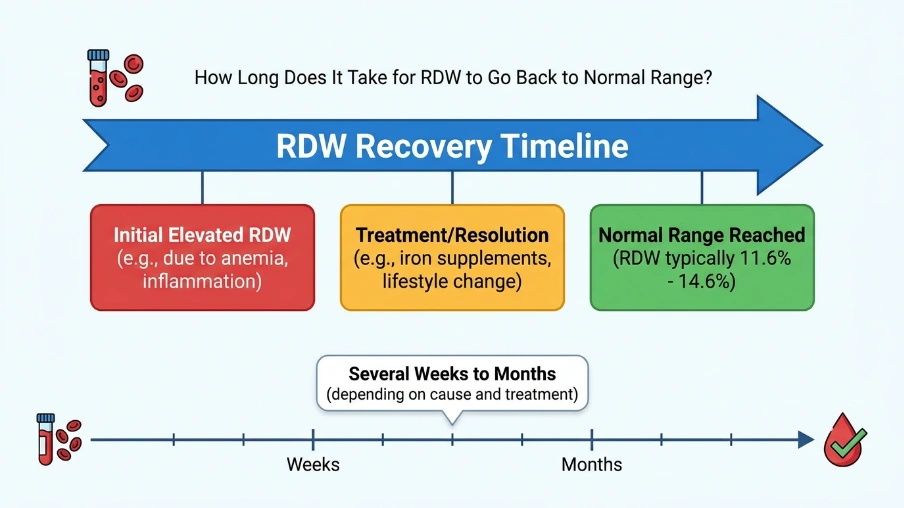

RDW (Red Cell Distribution Width) normally takes 1 to 3 months to return to its normal range when the underlying cause has been successfully treated. This timeframe is directly tied to how red blood cells naturally work in the body. Red blood cells have a lifecycle of roughly 100 to 120 days, that means your body cannot simply clear out old cells overnight . Instead, it produces healthier, more uniform cells that slowly replace the older ones in your bloodstream with the new ones.
The main thing to understand is that patience is essential. Your doctor will recheck your blood after few months to confirm that cells are going back toward normal, which lies between 11.5% and 14.5%.
What Is RDW?
Red blood cell distribution width (RDW) reflects erythrocyte size distribution, thus representing a reliable index of anisocytosis, widely used for the differential diagnosis of micro and normocytic anaemias. Along with the large use in diagnostic hematology, RDW Blood Test has been associated with presence and complications of a vast array of human pathologies during the last decades, including cardiovascular (CV) diseases.
- Hence aimed to provide an overview of important studies and systematic reviews with meta analysis, in which RDW has been associated with CV events and mortality, in the attempt of establishing whether enough evidence exists for supporting its routine use in clinical practice.
- According to available data it seems reasonable to conclude that although the diagnostic specificity is low, and this measure is still plagued by important lack of standardization, RDW can be regarded as an index of enhanced patient fragility and higher vulnerability to adverse outcomes.
- Abnormal RDW values shall hence persuade physicians to broaden the diagnostic reasoning over anaemias, especially those due to malnutrition or malabsorption, encompassing a comprehensive assessment of traditional and non traditional CV risk factors.
What RDW CV Measures
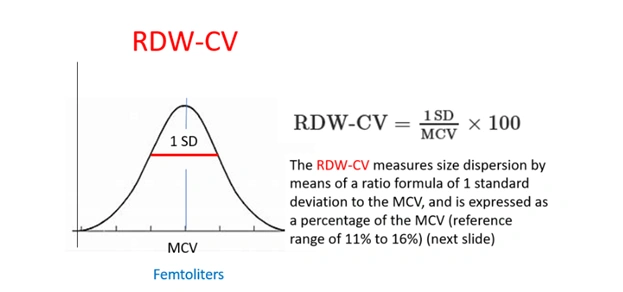
RDW CV is a calculated value. It equals RDW SD divided by the MCV, multiplied by 100. Because the denominator contains the MCV, the value is strongly influenced by microcytosis. A very low MCV can make the coefficient of variation appear high, even when the actual spread of red cell sizes is fairly narrow. RDW CV can therefore exaggerate variability in settings where the cells are uniformly small.
- On the first day, the RDW CV is elevated, while the RDW SD is within the reference range. This combination is typical of microcytosis with uniform cell size.
- The histogram is narrow, but the MCV is small enough that the RDW CV is inflated. This pattern can occur in thalassemia trait, but it is also seen in severe, longstanding iron deficiency, where the marrow has been producing uniformly small cells for some time.
- In late iron deficiency, the population becomes relatively homogeneous again, which allows the RDW SD to remain normal despite marked microcytosis. There is no significant anisocytosis at this point.
What RDW SD Measures
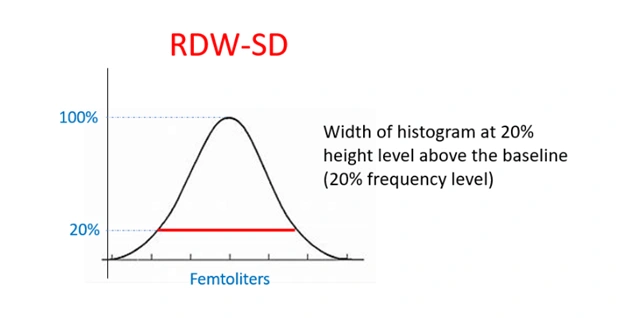
RDW SD is an absolute measure of the width of the red cell volume histogram at the 20 percent height mark. It does not use any ratios and is not dependent on the MCV. It increases only when the distribution truly widens. RDW SD is therefore the more reliable index when assessing anisocytosis, because it reflects real differences in cell size rather than mathematical effects created by changes in the mean.
On the second day, the RDW SD increases abruptly from 45.7 to 59.4. This reflects a true widening of the red cell distribution. Physiologic responses such as reticulocytosis after iron therapy or marrow recovery do not produce such a dramatic change within 24 hours.
A shift of this size over a single day occurs when a second population of red cells suddenly enters the circulation. The most common and most plausible explanation is transfusion of normal donor red cells into a microcytic host. The mixture of two populations, one microcytic and one normocytic, immediately broadens the histogram.
The Biological Reason This Takes So Long
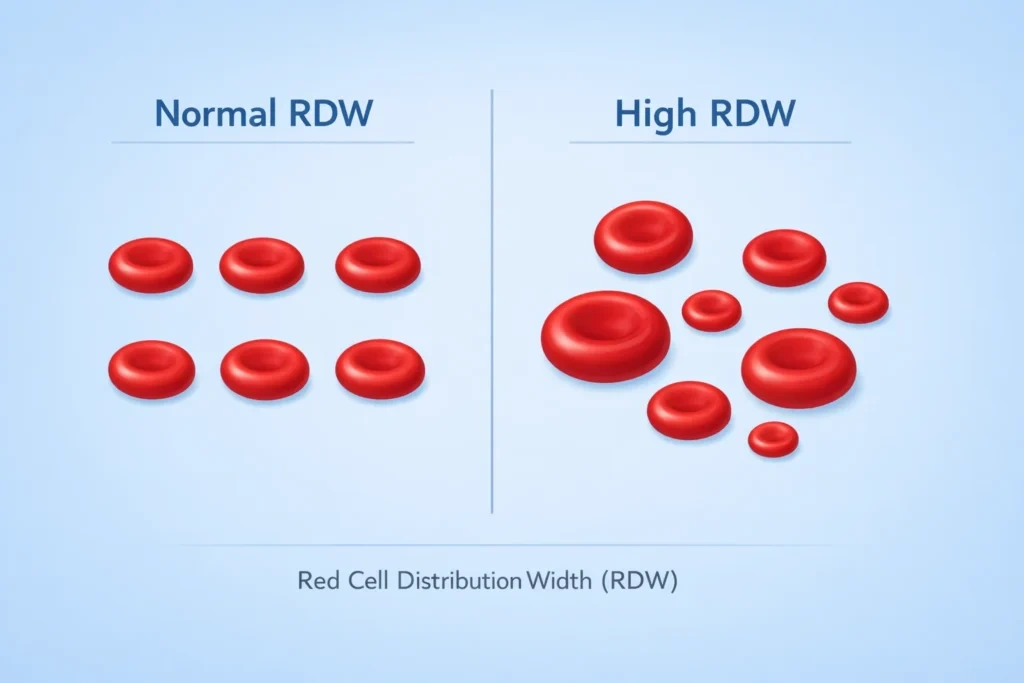
The biological reason RDW takes so long to go back to normal range because of 120 days life cycle of red blood cells (RBCs). Because RDW measures how much your red blood cells vary in size. In High RBW it is a mixture of small and big cells and in Normal RBW your cells are mostly the same size. If you start the treatment today your body will start making perfectly sized cells .
However the old cells are still floating around. The RDW wouldn’t look normal until the old cells completely dies and new cells take place.
Because of this process is slow process is slow, checking your blood again after a week wouldn’t show much changes , Doctors usually wait 2 to 3 months because, By 8 weeks, about half of your red blood cells have been replaced. By 12 weeks, almost the entire population is brand new.
Iron Deficiency Anemia
Iron deficiency anemia means your blood doesn’t have enough iron to make hemoglobin( the part of your blood that carries oxygen to your muscles and brain). If you have this condition you might always feel low , feeling exhausted even after a full night’s sleep, weakness , pale skin , shortness of breathe.
- It is treated with iron supplements and taking iron rich foods, improvements often seen within weeks. Iron deficiency anemia is a common type of anemia. Anemia is a condition in which the blood doesn’t have enough healthy red blood cells. Red blood cells carry oxygen to the body’s tissues.
- Not getting enough iron can cause iron deficiency. So can losing blood from having periods or bleeding inside the body. Without iron, the body can’t make enough of the part of red blood cells that lets them carry oxygen, called hemoglobin. As a result, iron deficiency anemia can cause tiredness and shortness of breath.
Vitamin B12 Deficiency
Vitamin B12 (cobalamin) is a water soluble vitamin that is derived from animal products such as red meat, dairy, and eggs. Intrinsic factor is a glycoprotein that is produced by parietal cells in the stomach and is necessary for the absorption of B12 in the terminal ileum. Once absorbed, B12 is used as a cofactor for enzymes that are involved in the synthesis of deoxyribonucleic acid (DNA), fatty acids, and myelin.
As a result, B12 deficiency can lead to hematologic and neurologic symptoms. B12 is stored in excess in the liver; however, in cases in which B12 cannot be absorbed for a prolonged period (eg, dietary insufficiency, malabsorption, lack of intrinsic factor), hepatic stores are depleted, and deficiency occurs.
Vitamin B12 deficiency is associated with certain symptoms, the most important of which are:
- Fatigue, weakness, and exhaustion.
- Tingling and numbness in the limbs.
- Pale skin without liver issues.
- Difficulty concentrating, memory loss, and some behavioral changes.
- Smooth spots on the tongue.
Folate Deficiency
Folate is a B vitamin that your body needs to work properly. Folate is especially important if you’re pregnant. Folate deficiency occurs when your body doesn’t get enough folate. Symptoms include fatigue, weakness, mouth sores and neurological issues. Folate deficiency can be prevented by eating a diet rich in foods that contain folate.
Folate deficiency is when your blood lacks the amount of vitamin B9 (folate) it needs to function properly. Folate deficiency can cause a wide range of symptoms and complications.
Folate deficiency can include
· Infertility
· Cancer risk
· Heart disease
· Depression
· Dementia
· Brain fog (Decreased cognitive function)
· Alzheimer’s disease
Chronic Disease / Inflammatory Conditions
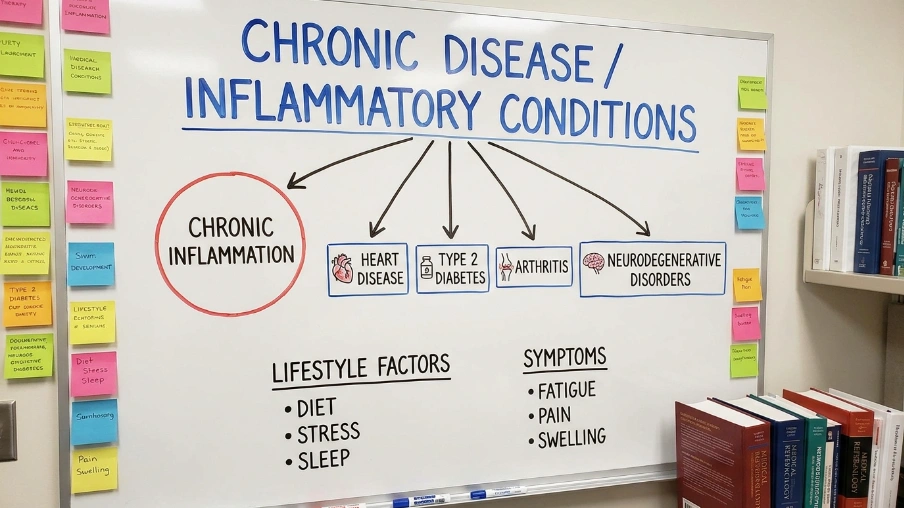
Chronic inflammation is also referred to as slow, long term inflammation lasting several months to years. Generally, the extent and effects of chronic inflammation vary with the cause of the injury and the ability of the body to repair and overcome the damage. This activity reviews the pathophysiology of chronic inflammation and highlights the role of the interprofessional team in taking steps to control the pathology.
Inflammation is part of the body’s defense mechanism. It is the process by which the immune system recognizes and removes harmful and foreign stimuli and begins the healing process. Inflammation can be either acute or chronic
Acute Inflammation
Tissue damage due to trauma, microbial invasion, or noxious compounds can induce acute inflammation. It starts rapidly, becomes severe in a short time and symptoms may last for a few days for example cellulitis or acute pneumonia. Subacute inflammation is the period between acute and chronic inflammation and may last 2 to 6 weeks.
Chronic Inflammation
Chronic inflammation is also referred to as slow, long term inflammation lasting for prolonged periods of several months to years. Generally, the extent and effects of chronic inflammation vary with the cause of the injury and the ability of the body to repair and overcome the damage. This article reviews chronic inflammation.
Summary Table
Here is a quick reference — these are estimates, not guarantees
| Cause | Approx. Timeline | Important Note |
| Iron Deficiency Anemia | 4.5 months (≈139 days) | RDW spikes early in treatment before falling — expected |
| B12 Deficiency | 3 months | Check folate and B12 together, not one alone |
| Folate Deficiency | 3 months | Very similar pattern to B12 |
| Chronic Inflammatory Disease | Months to indefinite | Depends entirely on disease management |
| Multiple Deficiencies Combined | 4–6+ months | Fixing one may unmask the other |
Why Is My RDW Still High After Months of Treatment?
RDW still high after the months of treatment because your body is still in the process of replacing old ( small or large cells ) with the new ones , or that an underlying cause is still present. While hemoglobin level often recovers faster, the RDW which measures the variation in red blood cell (RBC) sizes can take much time time to normalize, sometimes over 3 months.
- Ongoing Blood Loss: If you are treating anemia but still experiencing the issue, like chronic iron loss from heavy menstruation or gastrointestinal bleeding (eulcers, polyps), the RDW will not normalize.
- Poor Absorption (Malabsorption): If you are taking iron supplements but have conditions like Celiac disease, Crohn’s disease, or have had gastric bypass surgery, your body may not be absorbing the nutrients.
Mixed Deficiencies: You may have more than one deficiency. For instance, treating iron deficiency while having an untreated Vitamin \(B_{12}\) or folate deficiency will keep the RDW high because your body is producing both small and large cells simultaneously.
When Should You Get Retested
When you should get retested depends on your specific treatment goal (2 to 4 Weeks): Doctors recommend a CBC (Complete Blood Count) within a month after starting treatment. This check is to see if your hemoglobin is rising (ideally by at least 1 g/dL), but it is too early to see the RDW normalize. In this time the new healthy cells are started growing and mixing with the old ones.
- (2 to 3 Months): It is a more detailed retest it includes a CBC and iron panel. It is typically done after 2–3 months. This checks if your new red blood cells are becoming a more consistent, healthy size.
- (3 to 4.5+ Months): Red blood cells live for about 120 days, it takes 3 to 5 months for the RDW to replace all the old cells with the new ones. Retesting at this stage means that the old variably sized cells has been completely replaced by new healthy cells.

